The question “What is native?” first popped into my head earlier this summer while we were preparing for the Native Plant Sale at Fontenelle Forest in Bellevue. Someone asked whether a certain species counted as native, and suddenly we were knee deep in a conversation that went far beyond a simple yes or no. Does “native” mean regionally native? Climate‑based? Only within Nebraska’s border? Located within the lower 48?
After doing some digging, I realized that most people use the word native without ever defining it. So here’s a clear, practical breakdown of what “native” means and how we, at PlantNebraska, decide what qualifies for Nebraska
What Does “Native” Mean?
At its base, a native plant is one that evolved naturally in a region without human introduction. These plants developed alongside the local soils, wildlife, climate patterns and ecological processes. But here’s where things get complicated: a plant can be native to a single state, an entire region or even a whole continent. Each of those areas contains very different ecosystems. A plant that’s native to North America isn’t automatically native to Nebraska. So, the word native only becomes meaningful when you define the scale you’re talking about.
Nebraska Natives
A Nebraska native plant is a plant found within the man-made borders of the state based on historical records and ecological surveys. These are the plants that evolved directly inside our prairies, wetlands and river streams.
Some plants fall squarely into this category. For example, narrow-leaf coneflower (Echinacea angustifolia) is unquestionably a Nebraska native; it evolved right here in Nebraska’s state lines. But not every plant that feels native is truly native to Nebraska. That’s where the idea of regional natives comes in.
Regional Natives
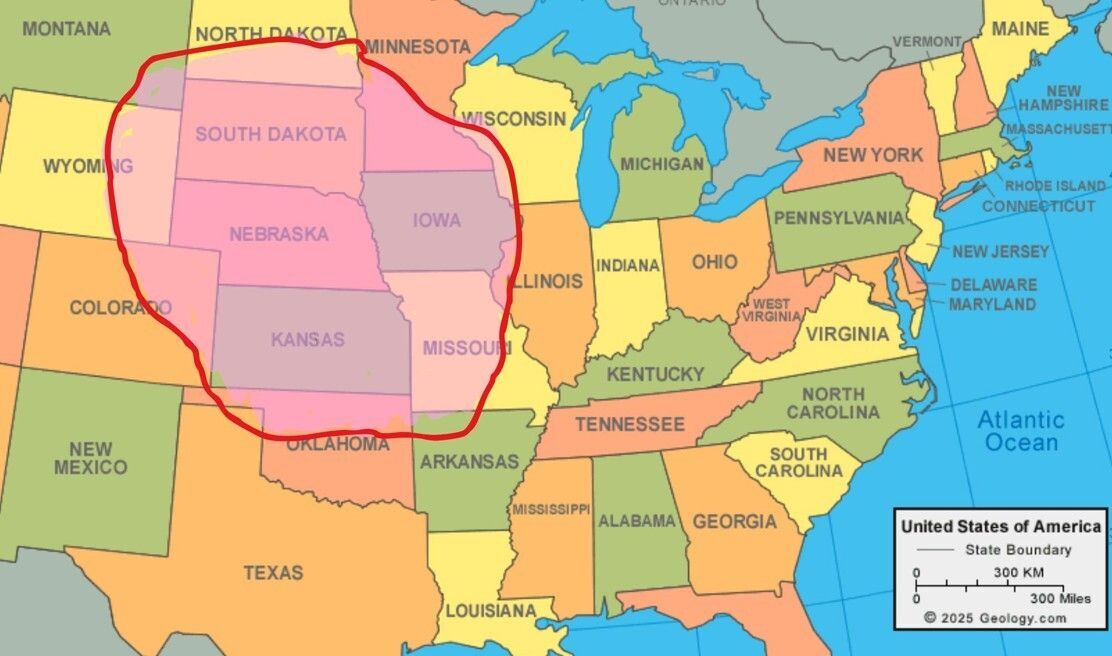
Regional natives are species that evolved within the broader Central Great Plains and tallgrass/mixed‑grass prairie region. This includes all of Nebraska plus Iowa, Kansas, South Dakota, most of Missouri, the eastern plains of Colorado and Wyoming, the southern prairie of Minnesota and the northern prairie of Oklahoma.
Following this approach makes so much more sense because ecosystems don’t follow state lines. A wet prairie in eastern Nebraska is nearly identical to one in western Iowa. A sandhills meadow shares more with parts of South Dakota than with a forest in southeastern Nebraska. Plants evolved with ecosystems, not political boundaries.
There are some species that fit perfectly into these lines. Ohio buckeye (Aesculus glabra), for example, is native to parts of the Midwest and fits more closely with a regional native than a strictly Nebraska native.
A Simple Rule to Follow
A plant can reasonably be considered regionally native if it naturally occurs within about 150–200 miles of Nebraska’s border and/or grows in a similar ecosystem. Once you go beyond this 150-200 mile radius, you would start including plants from the Appalachian forest region, the Gulf Coast wetland region, the Southwest desert region or the Pacific Coast region. While these plants may be native to the lower 48, they are not native to Nebraska's soils or climate, and they often will behave unpredictably when planted here. A good example of this is southern magnolia (Magnolia grandiflora). It's native to the lower 48, but it’s from the southeastern U.S., so it shouldn’t be counted as native for Nebraska.
My Thoughts
These definitions aren’t meant to box anyone in or dictate what you should plant. Nativeness is always context‑dependent, and people will naturally draw their own lines based on their goals, their landscape and their ideas. Some people cast a wide net and are perfectly comfortable planting North American native trees and shrubs that grow well here. Others prefer to stay closer to home, especially with prairie species, choosing plants native to the tallgrass, mixed‑grass or shortgrass regions within a couple hundred miles of Nebraska.
The planting site matters just as much as the plant itself. In a high‑quality remnant prairie or woodland, sticking with local species—and ideally local ecotype seed—helps preserve the integrity of that ecosystem. For restored prairies, acreages or backyards, there’s more room to explore and enjoy a broader palette, as long as you’re not introducing anything that could become invasive or threaten nearby natural areas.
So, plant natives when you can, learn about the species you choose and don’t feel guilty if your garden includes plants from outside Nebraska. The goal isn’t to have a strict native landscape—the goal is to plant Nebraska.