




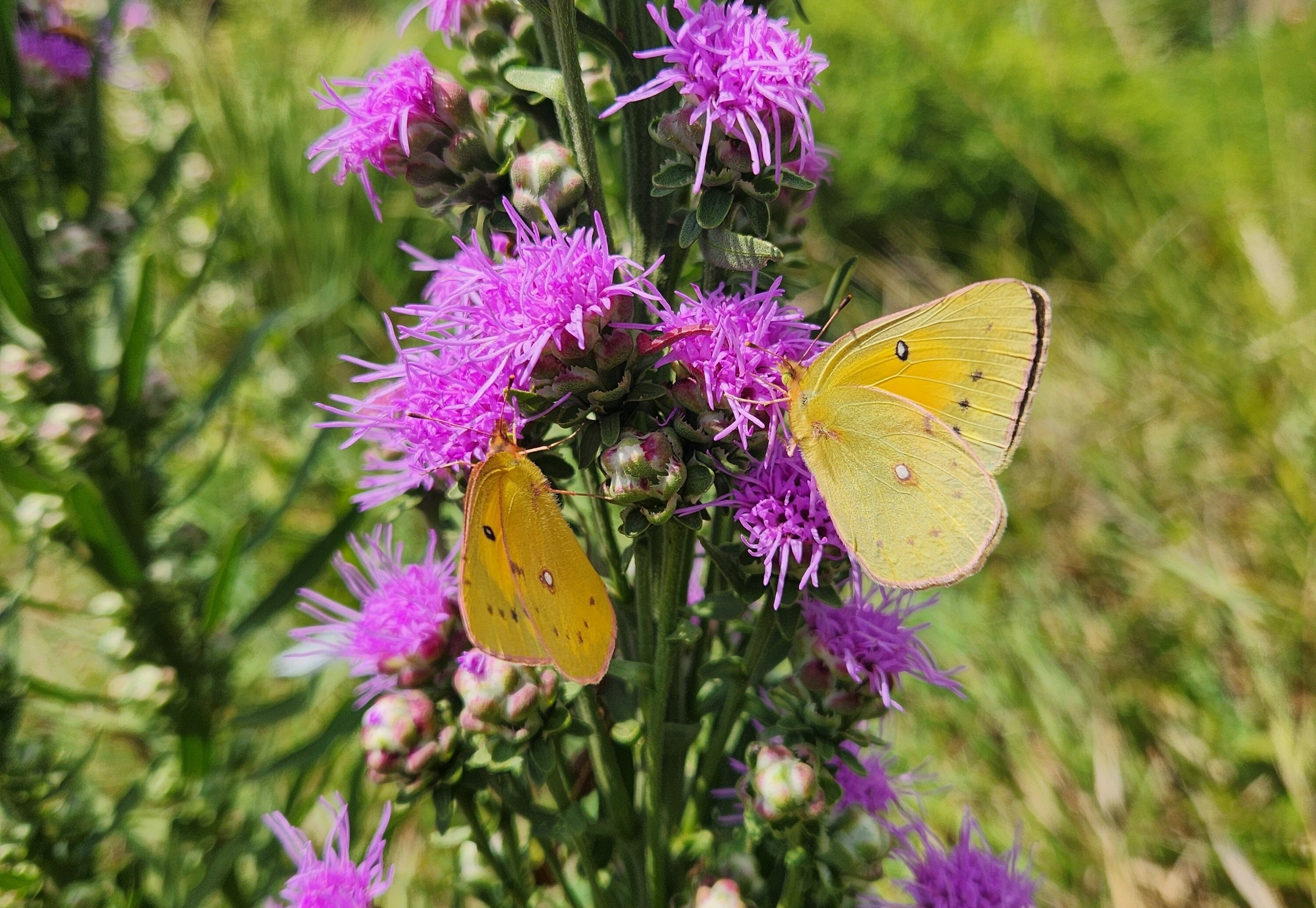
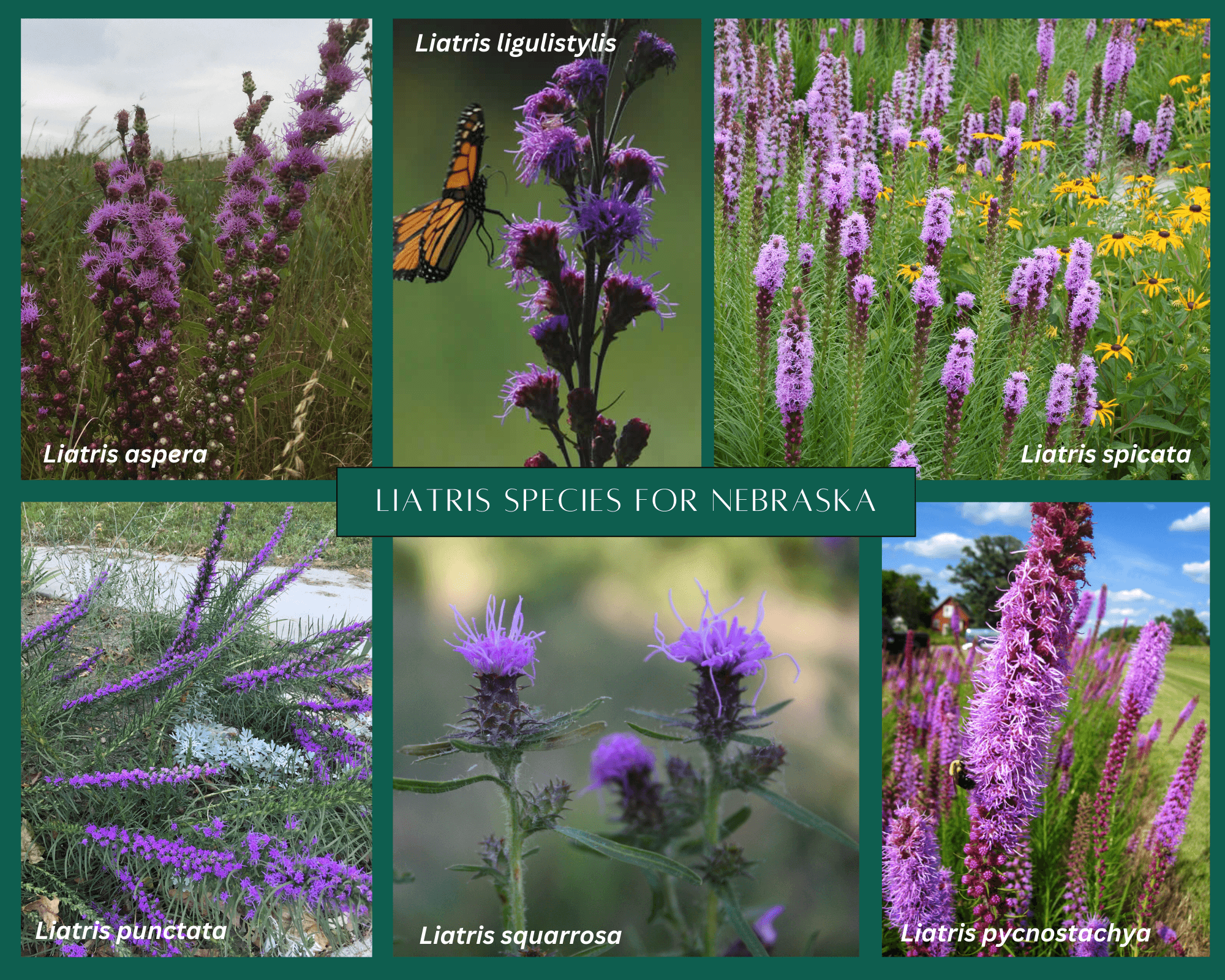
The vibrant purple flowers of Liatris (blazing star) are hard to pass by without stopping for a second look. One of the most eye-catching colors in a native plant collection, Liatris attract not only human attention but also a variety of butterflies and other insects. Next to milkweed, Liatris is one of the most important species to plant for monarchs, along with painted ladies; they can't resist the late summer buffet that feeds the 3rd and 4th generations born in Nebraska before the fall migration.
As gardeners, we love Liatris for its tall, sturdy flower stalks that bloom for several weeks. The stalks grow from a base of grass-like leaves and bloom from the top down over a 4-6 week period, some cultivars are selected for up to eight weeks of flower. They provide a structural component to a native plant garden that can be full of mounded or floppy species, and their seed heads provide a fun texture into the fall and winter. They also make beautiful cut flowers and, if cut early in their bloom time, last for years in a dried arrangement.
There are five Liatris species native to Nebraska and one close neighbor that grow reliably in the garden. They all prefer full sun but range in height, moisture and soil conditions. They grow from either corms or rhizomes and can be divided as they mature. For identification, the main differences are height and flower density on the stalk; the leaves are very similar, especially early in the season when they resemble a grassy tuft.
Common characteristics of all blazing star:
- Grow in full sun (6-8 hours) but tolerate part shade (4-6 hours)
- Grow best in sandy to loamy soil and prefer good drainage; can tolerate a range of moisture preferences
- Work well in rain gardens, either on upper sides or bottom
- Have a base of grass-like leaves
- Produce several stalks of bright purple flowers in late summer and early fall
- Are visited by hummingbirds, monarchs, painted ladies and a variety of other butterflies, bees and flies
- Are generally left alone by rabbits and deer but may be bothered by voles or ground squirrels for their corm or rhizome (depending on species)
Dotted blazing star (Liatris punctata):
- Shortest at 12-18"
- Medium-dry soil conditions, prefers good drainage
- Blooms July-September
- Grows well in both eastern and western Nebraska
- Native across Nebraska and the Great Plains
Meadow blazing star (Liatris ligulistylis):
- Tallest at 36-72"
- Medium-wet soil conditions; works well in rain gardens
- Blooms July-August
- Grows well in both eastern and western Nebraska
- Native in small part of the panhandle and Colorado, Mexico and South Dakota
- Known for its stunning number of flowers and as a monarch butterfly magnet; typically blooms right before their migration begins.
Prairie blazing star (Liatris pycnostachya):
- Tall at 36-60"
- Medium-wet soil conditions; works well in rain gardens and clay
- Blooms July-August
- Grows well in eastern Nebraska
- Native to eastern Great Plains and the Midwest
- Makes a great cut flower; 'Eureka' cultivar favored for amazing bloom length and size
Spiked or dense blazing star (Liatris spicata):
- Tall at 24-48"
- Medium-wet soil conditions; works well in rain gardens and well-drained sites
- Blooms July-August; shorter bloom time but 'Kobold' cultivar selected for longer blooms
- 'Alba' cultivar offers white flowers
- Grows well in eastern Nebraska
- Native to eastern US
Scaly blazing star (Liatris squarrosa):
- Medium height at 18-24"
- Medium-dry soil conditions, prefers sandy or rocky soils, flops in rich soil
- Blooms July-September
- Grows well in both eastern and western Nebraska
- Native across Nebraska, the Great Plains, and the southeastern US
- Larval host for blazingstar flower moth and other species
Button or rough blazing star (Liatris aspera):
- Medium height, 24-36"
- Medium-dry soil conditions, requires good drainage, does not want to be wet in the winter
- Ideal for poor and rocky soils
- Blooms July-October
- Flowers alternate on the stem, giving it a unique look from other species
- Grows well in western Nebraska; can work well in eastern Nebraska in dry sites
- Native to eastern and central Nebraska
More information about Liatris can be found by downloading our handy information sheet.