




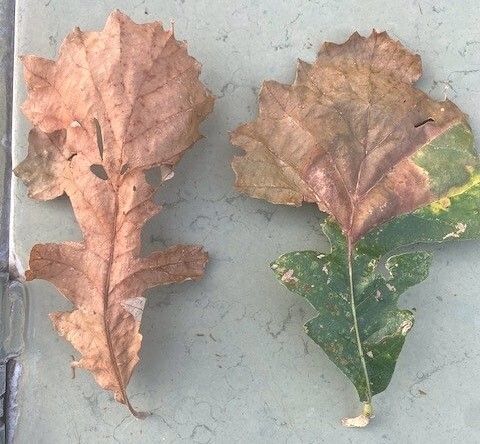
Image: Bur oak leaves indicating primary infection (left) and secondary infection (right).
Over the last several years, an increasing number of bur oaks (Quercus macrocarpa) in the eastern counties of the state have had browning leaves in late summer. After the leaves die, some drop to the ground and some stay on the tree through the winter months. The bur oaks may appear healthy the next spring only to show the same symptoms again throughout the summer. After several years the trees most affected start to have severe twig, branch dieback or even start to decline. These symptoms are common for a leaf blight disease called bur oak blight (BOB).
BOB (Tubakia iowensis) infects only bur oak trees and seems to be most severe on the subspecies Quercus macrocarpa var. oliviformis, which is found on higher, drier sites in eastern Nebraska, northeastern Kansas, Iowa and parts of Minnesota and Wisconsin.
BOB is caused by a primary infection and a secondary infection.
Primary infection of BOB causes diseased petioles that have stayed on the tree over the winter to infect new shoots as they are expanding in a wet spring. The new petiole and leaves attached to the infected shoots also become infected and die in late July to early August. The dead leaves either stay on the tree during the next winter or drop off, but the dead petioles remain and are a source of infection the following spring.
Secondary infection of BOB uses the same diseased petioles that have stayed on the tree over the winter to infect new leaves that are fully expanded in a wet summer. Dark purple-brown lesions on the underside of the leaf are visible with the naked eye that will cause necrosis along veins of the leaf. The secondary infection only causes defoliation and is not a major source of infection for the following year.
In most cases, BOB will be more prominent lower in the canopy and expand upward, eventually infecting the entire tree canopy. While it is uncertain if BOB can kill a tree, it is more likely that the tree will become highly susceptible to boring insects like the two-lined chestnut borer, and other diseases, like hypoxylon canker, after years of defoliation stress and decline.
You can help to protect your trees by mulching with wood chips and properly watering during dry periods. Drought has been a contributing factor to additional stress on bur oaks. Preliminary tests by Iowa State University of trunk injections of propiconazole right after leaves have matured and before symptoms appear (May to early June) have shown promise in control of BOB in the following season. In some cases, it is also recommended to control boring insects like the two-lined chestnut borer that infest bur oaks weakened by BOB.